Blazing-World’s unified and peaceful order
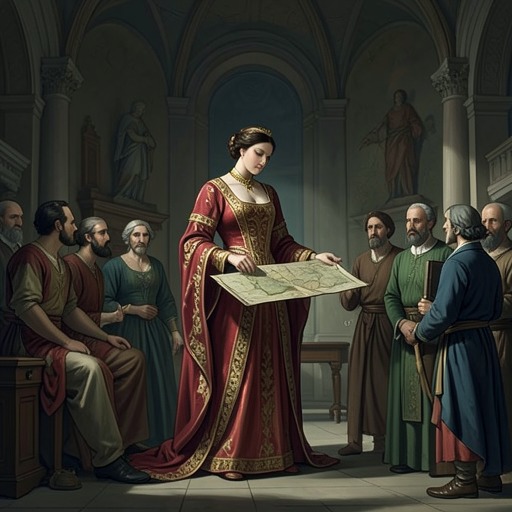
The Blazing WorldThe Blazing-World’s unified and peaceful order is built on the claim that one sovereign, one religion, one language, and one law can make an entire world function as a single family. When the Lady arrives, she finds a realm whose inhabitants submit to one Emperor and share one language; they are described as living in continued peace, without foreign wars or home-bred insurrections. Later, the Empress presents this earlier arrangement as the standard to which her divided realm must return. Its appeal is real, but so are its costs: unity is maintained through concentrated authority, limits on public participation, the containment of scholarly disputes, and, beyond the realm’s borders, the threat and use of force.
Origins and Political Design
The order is introduced through the Lady’s arrival at Paradise, the imperial city. The surrounding region is divided by rivers into islands, and its entrance is a single winding passage among the rocks, navigable only by small boats carrying no more than three passengers. The geography supplies a material image of political enclosure: the realm has one narrow approach, while its inhabitants have one language and one Emperor. The account directly connects that political and linguistic unity to peace and security from invasion and rebellion.
The Empress later asks the statesmen why the realm has so few laws and why it favors monarchy. They answer that multiplying laws produces divisions, which can foster factions and eventually open war. Their defense of a single ruler follows the same logic: as one body has one head, they argue, a political body should have one governor; a commonwealth with many governors would resemble a many-headed monster. They also align monarchy with religious doctrine, reasoning that one God worshipped in one faith corresponds to one Emperor obeyed by all. In this account, simplicity is not merely administrative convenience. It is the structure that makes political obedience resemble religious unity.
Religion, Membership, and Exclusion
The inhabitants tell the Empress that they have one religion and no diversity of opinion about the worship of God. They do not identify themselves as Jewish, Turkish, or Christian; instead, they describe unanimous worship of one eternal and omnipotent God. Their public devotion consists of prayers shaped as petitions, humiliations, and thanksgiving. Separate places of worship for different kinds of inhabitants do not, in their explanation, imply separate religions.
That shared faith is not equally expressed by everyone. Women are barred from the public congregations and pray at home in private. The priests justify the exclusion by saying mixed gatherings distract men from worship, and they further claim that women can influence husbands and parents in ways that disturb Church and State. Priests and governors are princes of the Imperial Blood made eunuchs to prevent marriage; their explanation likewise treats family ties as a political risk. The system presents religious uniformity as universal while restricting who may participate publicly and who may hold office. Its peace therefore depends not only on common belief but on a hierarchy that assigns different civic and religious roles.
Learning Under Imperial Authority
The Empress grants learned societies roles suited, in her view, to the characteristic aptitudes of the different peoples. Bear-men become experimental philosophers, Bird-men astronomers, Fly-men, Worm-men, and Fish-men natural philosophers, Ape-men chemists, Satyrs physicians, Fox-men politicians, Spider-men and Lice-men mathematicians, and Giants architects. She encourages useful arts and sciences, establishes schools, and founds societies. Learning is thus part of the realm’s organized public life, but it is also classified and administered from the throne.
The boundary between permitted inquiry and political disorder becomes clear in the dispute over the Bear-men’s optical instruments. The Empress orders the Telescopes broken after concluding that they mislead the senses. The Bear-men plead to keep them, explaining that disputes give their work its pleasure and provide occasions to contradict one another. She relents on condition that their quarrels remain within their schools and do not produce factions or disturb government. The episode makes intellectual disagreement an exception tolerated only under containment: the societies may argue, but their arguments must not become a rival source of political allegiance.
The same concern shapes the Empress’s later judgment of the societies. She fears that disputes may spread from learning into religion, policy, and law, bringing ruin to Church and State. When she worries that contentions among the Worm-men, Bear-men, Fly-men, Ape-men, Satyrs, Spider-men, and others may erupt into rebellion, she seeks the Duchess’s advice. The Duchess recommends restoring the government’s earlier form: one sovereign, one religion, one law, and one language. She argues that learning commonly brings controversy, as scholars compete over who is wiser or nearer to truth, and that disputes within schools can grow into factions and wars. In her remedy, the Empress should dissolve the societies rather than risk disorder for the sake of their intelligence.
The Empress hesitates because changing her own decrees, acts, and laws might seem an admission of disgrace. The Duchess reframes revision as evidence of wisdom and goodness: a ruler gains honor by recognizing error rather than persisting in it. The Empress accepts her friend’s counsel, and their exchange links political restoration to the intimacy of their friendship. The earlier arrangement is not simply an inherited constitution; it becomes a deliberate choice made in response to the failure of the Empress’s altered government.
Conversion and the Instruments of Persuasion
The Empress’s religious project both reinforces the realm’s unity and changes the means by which it is secured. Dissatisfied with what she sees as the people’s incomplete knowledge of divine truth, she builds churches and establishes a congregation for women, placing herself at its head and teaching the faith. The women become devout, and the Empress’s preaching wins her extensive affection among her subjects. Her effort gives women a religious assembly of their own, though it does not erase the existing account of their exclusion from the established public congregations.
To sustain belief, the Empress constructs two chapels at the center of a dark, circular cloister. One is lined with Diamonds and uses a Fire-stone that flames when wetted by water brought through artificial pipes; the other is lined with Star-stone and gives a cool, comforting light. The chapels rotate continuously in opposite directions. In the fiery chapel, the Empress preaches terror and punishment; in the luminous chapel, she offers comfort to those who repent. The staged contrast turns religious teaching into a visible, recurring spectacle. The narrative says that she uses art and ingenuity to convert the Blazing-World without compulsion or bloodshed, while showing how carefully designed theatrical effects help secure belief.
Peace, Force, and the Limits of the Ideal
The order’s claim to peace is strongest within its borders. The Empress’s court is described as needing no guard for security because there are no rebels or enemies; its Giants serve as a guard of state, and the people’s recreations include races, music, dancing, and feasts. These scenes give political calm a daily texture: order makes leisure possible, and different peoples take part through distinct contests and performances. The account’s final description of the realm as peaceful and tranquil rests on a society where public life has been brought under a common sovereign and common institutions.
Beyond the realm, however, the Empress’s rule is joined to coercion. In her native world’s war, she directs the Fish-men to use Fire-stones against enemy ships; the fleets burn and explode, and she refuses to return until the other nations submit to her homeland. When maritime nations reject her demand that they pay tribute to the King of Esfi, she orders their trading ships destroyed. In addressing the princes, she calls the King’s cause just and his power absolute, then counsels the rulers to pay tribute so they may live peacefully. Peace is offered as the benefit of submission, with destruction as the alternative. The difference between domestic concord and imperial expansion exposes the limits of the ideal: unity within the realm coexists with force used to impose a wider hierarchy.
The Duchess’s final description of the Empress’s world as governed by one religion, one language, and one government affirms its deliberate contrast with a world of competing rulers, laws, ambitions, and controversies. The author likewise says that she made the Blazing-World peaceful, though she could have imagined it full of factions and wars. That contrast is also a statement about imaginative sovereignty: the world can be composed according to a chosen political design. Yet the plot’s rebellions, restrictions, conversion strategies, and campaigns show that tranquility is not simply the absence of conflict. It is an achieved and guarded condition, sustained by the concentration of authority and, when the Empress turns outward, by the power to compel others.